
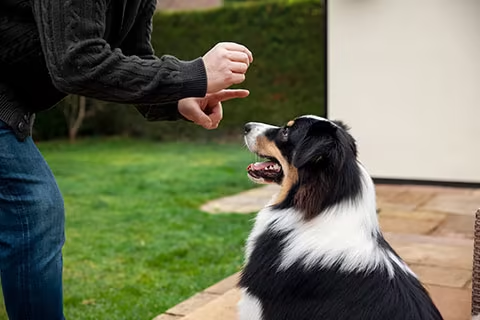
If your dog doesn’t consistently follow commands, daily life becomes frustrating fast. Obedience training gives your dog structure, improves control, and prevents common behavior problems before they develop.
In dog obedience training in Kansas City, we see many dogs that are labeled “stubborn,” but the real issue is a lack of clear, consistent training at home. When expectations are simple and repeated daily, most dogs improve quickly.
Quick Answer: How to Start Obedience Training
Obedience training starts with a few core commands practiced consistently in real-life situations. The goal is not perfection – it’s clarity and repetition.
To build reliable obedience:
- Start with 3 – 4 basic commands
- Train in short sessions throughout the day
- Use the same commands every time
- Reward correct behavior immediately
- Practice beyond just one room
- Stay consistent with rules
Obedience improves when your dog clearly understands what is expected in every situation.
Why Obedience Training Matters
Obedience is not just about teaching commands – it shapes how your dog behaves in everyday life.
Without structure, dogs make their own decisions. That often leads to behaviors like pulling on the leash, jumping on guests, ignoring commands, or reacting to distractions.
In many cases we see during dog training in Kansas City, these problems are not personality traits – they are the result of inconsistent training.
For example:
- A dog that jumps has learned it gets attention
- A dog that ignores “come” has never been reinforced consistently
- A dog that pulls has never been taught leash boundaries
Dogs repeat what works. Obedience training changes what works.
Step-by-Step Training Solution for Dog Obedience Training Kansas City
1. Start with Core Commands That Matter
Every dog should reliably understand a small group of foundational commands before anything advanced.
Focus on:
- Sit (builds control and patience)
- Come (essential for safety and recall)
- Place (teaches calm behavior)
- Leave it (prevents unwanted actions)
Trying to teach too many commands too quickly creates confusion. It’s better to build strong reliability with a few commands first.
For example, a solid “sit” can be used in many situations:
- Before feeding
- Before going outside
- When guests arrive
Simple commands used consistently create real-life obedience.
2. Train in Short Sessions Throughout the Day
Dogs learn through repetition, not long training sessions.
Instead of one long session, spread training across your day. This keeps your dog engaged and improves retention.
A simple routine might include:
- 5 minutes in the morning
- 5 minutes before meals
- Quick commands during walks
- Short practice in the evening
This approach builds obedience naturally into your daily routine instead of treating it as a separate activity.
Frequent short sessions create faster and more reliable learning.
3. Use Clear Timing for Rewards and Corrections
Timing is one of the most overlooked parts of obedience training.
Your dog learns based on what happens immediately after their behavior.
- Reward right when the dog follows the command
- Correct right when the dog ignores or breaks it
If you delay your response, the dog cannot connect the action with the outcome.
For example:
If your dog sits but you reward 5 seconds later, the dog may associate the reward with something else.
Clear timing creates clear communication.
4. Practice Commands in Real Situations
Many dogs listen at home but ignore commands outside. This happens because training only occurred in one environment.
To build real obedience, practice in different situations:
- During walks
- Around distractions
- When guests visit
- In different rooms of the house
In in-home dog training Kansas City, we focus heavily on real-life training because behavior must work outside of controlled conditions.
A command is only reliable if your dog follows it everywhere, not just at home.
5. Build Control Gradually
Once your dog understands a command, the next step is building reliability.
This means increasing:
- Duration (holding a command longer)
- Distance (responding from further away)
- Distractions (listening in busy environments)
For example:
Ask your dog to “place” and gradually increase how long they stay there while you move around or introduce distractions.
Control is built step by step, not all at once.
6. Create Consistency in the Household
Dogs learn patterns from repetition. If rules change depending on the person or situation, the dog becomes inconsistent.
Make sure:
- Everyone uses the same commands
- Rules are followed daily
- Behavior is corrected consistently
For example:
If one person allows jumping and another corrects it, the dog will continue to test the behavior.
Consistency across people creates consistency in behavior.
7. Reinforce Calm, Neutral Behavior
Obedience is not just about responding to commands – it’s about how your dog behaves between commands.
Reward your dog when they are:
- Calm in the house
- Relaxed around people
- Not reacting to distractions
Many dogs struggle with obedience because they are always in a heightened state of excitement.
Calm behavior must be reinforced if you want a controlled dog.
Common Mistakes to Avoid
Most obedience problems come from simple but repeated mistakes.
Avoid these:
- Repeating commands multiple times
- Only training once a day
- Using different words for the same command
- Expecting immediate results
- Not practicing outside the home
- Inconsistent rules between family members
For example, saying “sit” five times teaches your dog they can ignore the first four commands.
Clear, consistent communication is more effective than repetition.
When to Consider Professional Training
Some dogs need more structured guidance, especially when behavior patterns are already established.
You should consider help if:
- Your dog ignores commands consistently
- Behavior worsens outside the home
- Leash pulling is difficult to manage
- Your dog reacts strongly to distractions
- You’re unsure how to correct behavior
With in-home dog training in Kansas City, training happens where your dog naturally behaves. This allows for immediate correction and faster improvement.
Training in the real environment leads to more reliable results.
Why In-Home Dog Training Works Best in Kansas City
Dogs do not automatically apply commands in every environment. They learn based on context.
That’s why dog obedience training in Kansas City is most effective when done at home, where daily behaviors occur.
In-home training allows you to:
- Practice commands during real routines
- Address everyday distractions
- Build consistency in your environment
- Involve all family members
For example, teaching “place” in your living room helps your dog stay calm when guests arrive – something that cannot be fully replicated in a training facility.
Dogs learn best where they live, not just where they train.
FAQ: Dog Obedience Training Kansas City
What command should I teach first?
Start with “sit” because it builds control and is easy to use in daily situations.
How long does obedience training take?
Most dogs show improvement within a few weeks, but long-term success depends on daily consistency.
Can older dogs still learn obedience?
Yes. Dogs of any age can learn new behaviors with proper structure and repetition.
Why does my dog ignore commands outside?
Because training has not been practiced in different environments. Dogs need exposure to distractions.
How often should I train my dog?
Short sessions throughout the day work best. Consistency matters more than duration.
Final Thoughts
Obedience training is not about controlling your dog – it’s about creating clear communication and structure.
When your dog understands what is expected and sees consistent results, behavior improves naturally.
At Marquis Dog Training, we focus on trust-based, dog obedience training Kansas City, helping dogs build reliable behavior in real-life situations.
Consistent training, clear expectations, and daily repetition are what turn an untrained dog into a well-behaved one.