
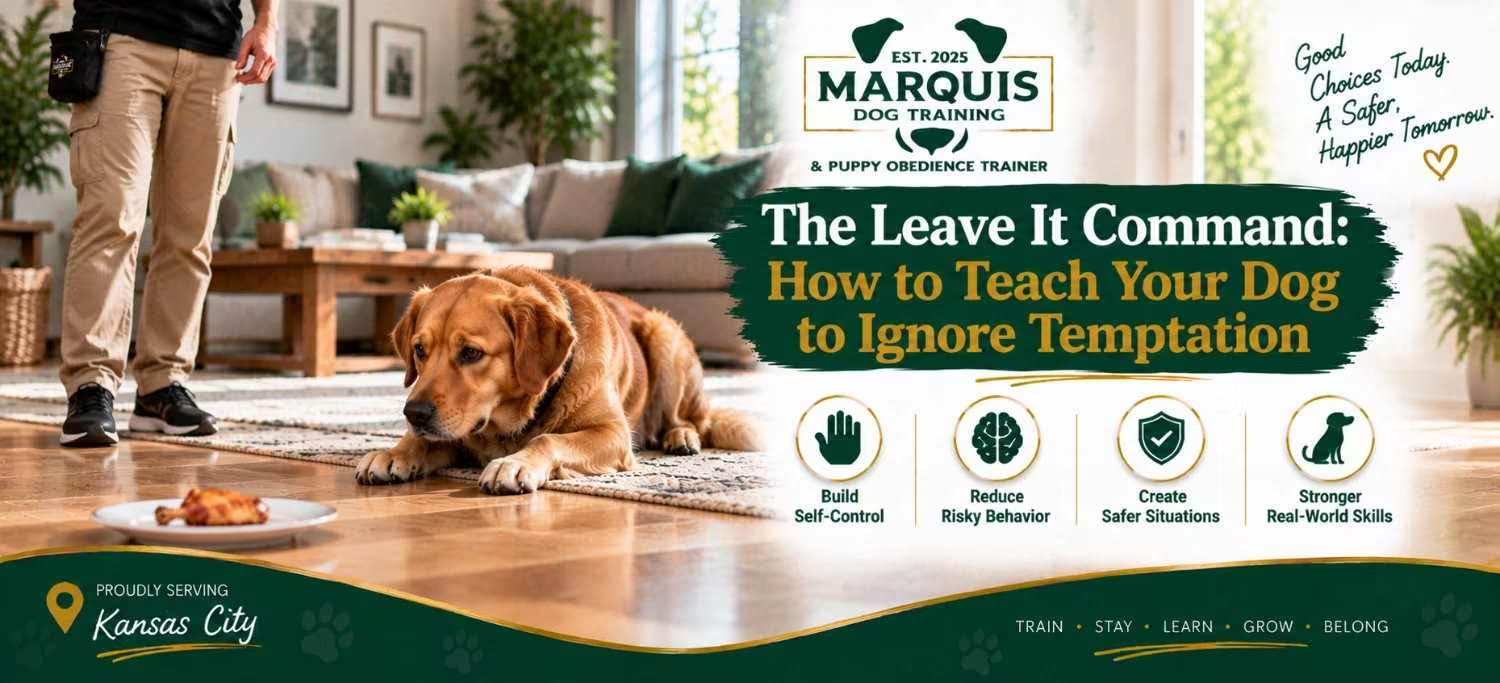
The leave it command is one of the most practical skills a dog can learn, and it earns its keep in situations that range from mildly annoying to genuinely dangerous. It tells your dog to ignore something they’re interested in, whether that’s a dropped sandwich, a chicken bone on a walk, a pill that rolled under the couch, or a squirrel across the street. Unlike a general “no,” it gives your dog a clear, rewarded alternative: look away from the thing, look at you, and get something better.
It is also one of the clearest examples of impulse control in action, which is why it sits at the core of our Obedience Training program alongside skills like sit, stay, and recall. A dog who can pause and choose not to grab something is a dog who is easier to live with and safer to take out in the world.
What the Leave It Command Actually Teaches
Many owners assume the leave it command means “don’t touch that.” In practice it teaches something more useful: when your dog notices something tempting, the best move is to check in with you. That shift matters because it works for objects, food, other animals, and situations you can’t predict in advance.
Dogs don’t learn this by being corrected for reaching. They learn it because ignoring the temptation reliably earns something better. Over time, the behavior becomes a habit rather than a negotiation, which is what makes it dependable when it really counts.
Why the Leave It Command Matters in Everyday Life
- Stopping a dog from eating something unsafe on walks, like food scraps, trash, or bones
- Keeping curious puppies away from shoes, remotes, and anything else they’d love to chew
- Reducing counter-surfing and snatching food off low tables
- Interrupting fixation on squirrels, bikes, or other dogs before it turns into pulling or lunging
- Giving you a calm, reliable way to redirect your dog around guests and kids
It pairs naturally with other foundation skills. If your dog already has a solid recall, leave it adds a second “emergency brake” for the moments when coming back isn’t enough on its own.
What You Need Before You Start
The setup is simple. You need two kinds of treats: a lower-value one for the “temptation” and a higher-value one for the reward, such as small pieces of soft chicken or cheese. You also need a short leash for later stages, a quiet room, and a few minutes of patience. Before you begin, decide on your release word, such as “take it,” so your dog knows when ignoring something is over and they’re allowed to have the treat.
The American Kennel Club’s guide to teaching the leave it command lays out a similar progression, starting with a treat in a closed hand and building up to floor treats and real-world distractions. The steps below follow the same logic with a few practical additions.
How to Teach the Leave It Command Step by Step
Step 1: Start with a closed hand
Hold a low-value treat in a closed fist and let your dog sniff, lick, or paw at it. Wait. The moment your dog backs off or even pauses for a split second, mark it with a word like “yes” and reward from your other hand with the better treat. Don’t give your dog the treat from the fist, because that teaches the opposite lesson. Gradually ask for a slightly longer pause before marking.
Step 2: Move the temptation to the floor
Place a low-value treat on the floor and cover it with your hand. If your dog tries to dig under your hand, wait. When they back off, mark and reward with the better treat from your other hand. Over several repetitions, start uncovering the treat a little at a time. If your dog lunges for it, cover it again and slow down.
Step 3: Add the cue word
Once your dog is reliably backing off, say “leave it” just before you place the treat down. Then reward the moment they ignore it. Adding the word after the behavior is already reliable keeps the association clean, and it means the cue predicts something your dog already knows how to do.
Step 4: Add leash and movement
Next, practice on a leash and let your dog walk past a few low-value treats on the ground. Say the cue, reward the moment your dog looks away, and keep walking. Using a leash makes sure your dog can’t reach anything you miss, and practicing while moving prepares you for the situations where you’ll actually need it.
Step 5: Add distractions and real-world items
Practice with different objects, such as toys, socks, and a dropped napkin, and in different places like the yard, the driveway, and the sidewalk. Then add people or other animals at a comfortable distance. If your dog starts to struggle, return to an easier step. Moving too fast is the most common reason the leave it command falls apart in real life.
How to Practice Without Wearing the Cue Out
A good rule is to use the cue only when your dog is likely to succeed. If you say “leave it” over and over while your dog ignores you, the words become background noise. In the early stages, set up practice so success is almost guaranteed, then gradually raise the difficulty.
Short sessions work best. Two or three minutes at a time, a few times a day, builds the habit faster than one long session. Keep the rewards genuinely worth leaving the temptation for, and vary them so your dog never knows exactly what’s coming.
Troubleshooting the Leave It Command
- Your dog grabs the treat anyway. The temptation is too high for this step. Go back to a lower-value item or a closed hand and shorten the wait.
- Your dog stares at the treat instead of looking away. Reward the first glance toward you, then slowly ask for more.
- The behavior works at home but not outside. Outdoor environments are much harder. Practice with low-value items and short distances first.
- Your dog ignores the cue around big triggers like squirrels. Build up from easier distractions and keep the leash on while you practice.
Common Mistakes to Avoid
- Rewarding from the temptation itself. If your dog gets the covered treat after backing off, they learn that waiting simply unlocks it. Always pay from your other hand with something better.
- Repeating the cue. Say it once, then help your dog succeed. Stacking cues teaches your dog to wait for the third or fourth one.
- Skipping the release word. Without a clear signal that the exercise is over, many dogs invent their own end point, usually earlier than you’d like.
- Punishing reaching. Scolding a dog for going after something tends to create tension and, in some dogs, guarding, rather than a calm choice to look away.
- Moving too fast. Jumping from a closed fist to a squirrel in the park sets your dog up to fail and weakens the cue.
Safety Notes Worth Knowing
The AKC points out that some items dogs find on the ground, such as cooked bones and certain medications, can be dangerous. A leash keeps your dog from reaching things you miss, and it’s worth reserving the leave it command for situations where your dog is likely to obey, so they don’t learn to tune it out. If your dog does swallow something dangerous, contact your veterinarian right away rather than waiting to see what happens.
For dogs who tend to grab and chew everything in reach, this skill works best alongside good management. Our article on destructive chewing and digging explains why dogs do it and how to redirect it.
When to Get Professional Help
Most dogs pick up the leave it command with consistent, short practice. If your dog guards items, growls when you approach something they’ve picked up, or becomes tense when asked to leave something alone, that is a different problem and deserves professional guidance rather than more repetitions of the same exercise. Our Obedience Training program builds impulse control step by step and can be adjusted to dogs who find it especially hard.
Frequently Asked Questions
What is the difference between leave it and drop it?
Leave it asks your dog to ignore something before they’ve picked it up. Drop it asks them to let go of something already in their mouth. They are related but taught separately.
At what age can I start teaching the leave it command?
Most puppies can begin simple closed-hand exercises as soon as they’re settled in at home. Keep sessions very short and fun.
Can I use the leave it command on walks?
Yes, once your dog is reliable at home and in the yard. Use a leash and low-value distractions first, then build up gradually.
How long does it take?
Most dogs understand the basic idea within a few short sessions, but dependable behavior around real distractions takes weeks of consistent practice.
My dog leaves it at home but grabs things outside. Why?
Outdoor environments are far more exciting. Go back a step, practice with easier temptations outside, and raise the difficulty gradually.
If you’d like help building a reliable leave it command that holds up on walks and around the house, a complimentary in-home visit is a good place to start.